Menu
Close

To provide the best experience, we use technologies like cookies to store and/or access device information. Consenting to these technologies will allow us to provide data such as browsing behaviour or unique IDs on this site. Not consenting or withdrawing consent may adversley affect certain features and fucntions.
Allow All
For teams building RFNBO projects, certification has shifted from a downstream concern to a live operational question. It is no longer just paperwork to handle when a project is operational; it shapes commercial outcomes long before the first molecules flow.
In our recent webinar, we asked attendees how their teams are currently thinking about RFNBO certification. The responses lined up with what we see day to day: 37% placed certification as a top priority, and another 33% said it was important but competing with other workstreams. We’ve spent the last year and a half at the operational edge of this.

Since launching at the end of 2024, Atmen has worked with 31 certifiable entities, 22 of which have completed their first audit.Two things stand out: nailing compliance has a direct, quantifiable impact on plant economics, and the workload behind it is enormous:
The lesson is clear: certification is now a central factor in project planning and execution. Most teams recognize its importance, the next challenge is implementing it effectively.
In practice, three key operational levers decide whether a project succeeds by aligning with the market or faces obstacles. Treating these levers as opportunities for optimization (rather than just compliance hurdles) has shown to bring direct commercial benefits.

Knowing the rules isn’t enough to qualify as RFNBO. The Delegated Act on Article 27 sets out several compliance paths: Power Purchase Agreements (PPAs) with additionality, geographic and temporal correlation, direct-line connections, grid sourcing during low-price hours, and sourcing from clean grids above 90% renewables. Each has its own compliance rules to prove.
The real difficulty starts when you combine paths. Take a plant with a properly sized PPA and access to low-price hours.
These questions come up regularly in our audits, and the answers directly affect Operating Expenses.
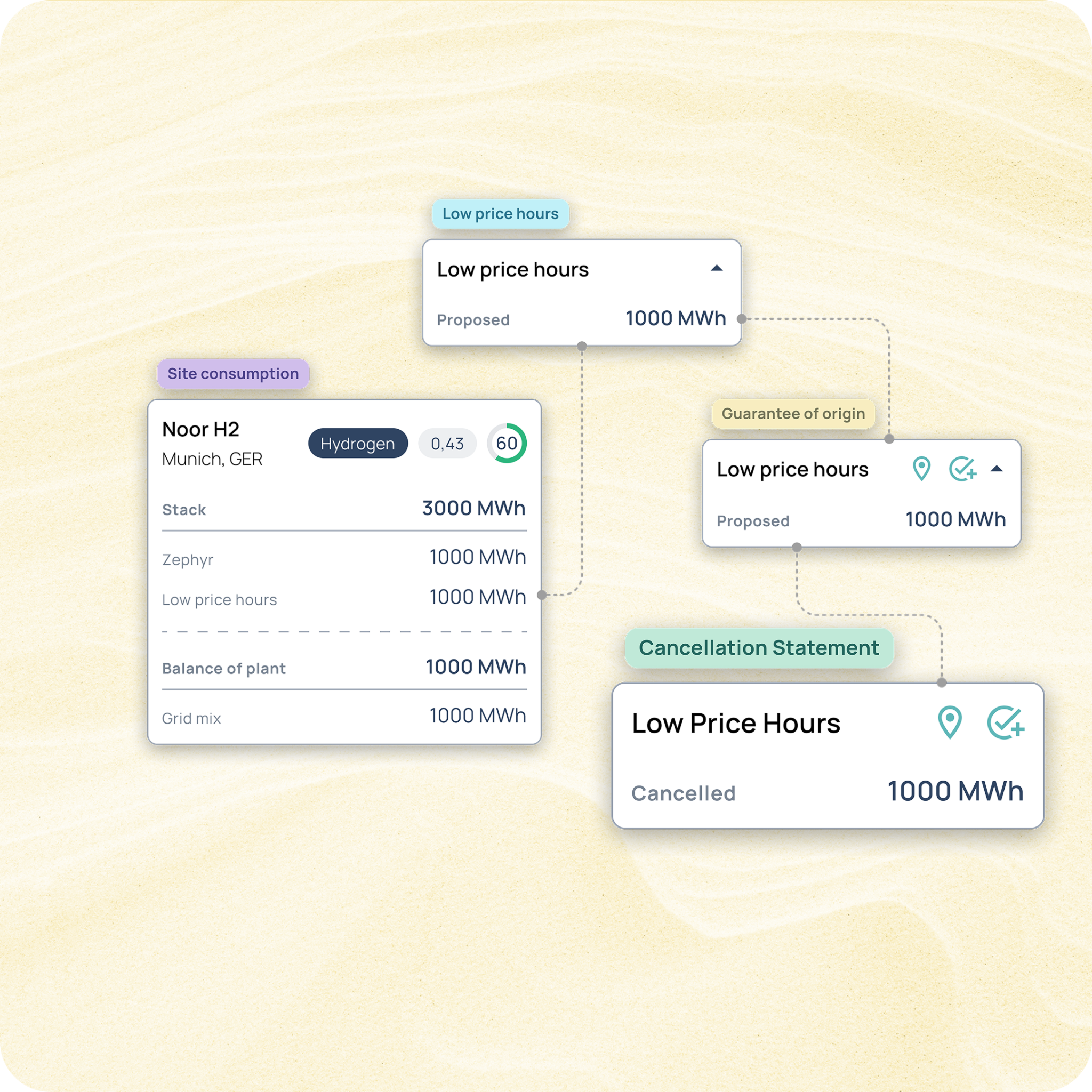
Another question we see: how do you optimally match site electricity consumption with various supply sources, for example, allocating qualifying electricity between your stack and balance of plant?
You don’t need to match everything with green electricity, but depending on what you’re optimizing for, you may want to. If you are optimizing for the lowest CI, make sure you only select zero- or low-carbon electricity supply options. If you optimize for cost, make sure you use as much grid mix as you can within the limit of what’s compliant at the site level.
The allocation game matters as much as the sourcing strategy.
What we see working: combining electricity market signals with operational consumption data and ranking green power sources in a clear order.
Two further refinements separate the strong operators from the rest.
First: The balance of plant doesn't need to be 100% green-compliant. Scarce PPA volumes should go to stacks first, with BoP using less-constrained sources where possible. Done well, this kind of internal allocation can free up to 10% of green compliant power volumes, a tradable surplus that would otherwise sit on the books.
Second: GO cancellation can be handled smarter. For stacks, cancel GOs that are time- and location-correlated with the PPA asset. For Balance of Plant (BoP), the right approach depends on the off-taker. Sensitive to CI? Use banked GOs from previous months. Not sensitive? You may not need to cancel at all.
A question we also get often: Can you combine PPA, grid mix, and low-price hours in the same hour?
In principle, yes. Your electrolyzer's load can be filled from multiple sources at once. The catch is that grid mix and qualifying low-price-hour consumption behave mechanically the same way: both draw from the grid.
The difference is the emission factor (zero during a qualifying low-price hour, grid intensity otherwise) and the GO logic around each. The audit risk isn't in combining; it's in not being able to explain cleanly where each MWh came from and how each is treated.
None of this works without strong data management. The point isn't that the tactics are complex; it's that they only pay off when the underlying data is structured, continuous, and audit-ready.
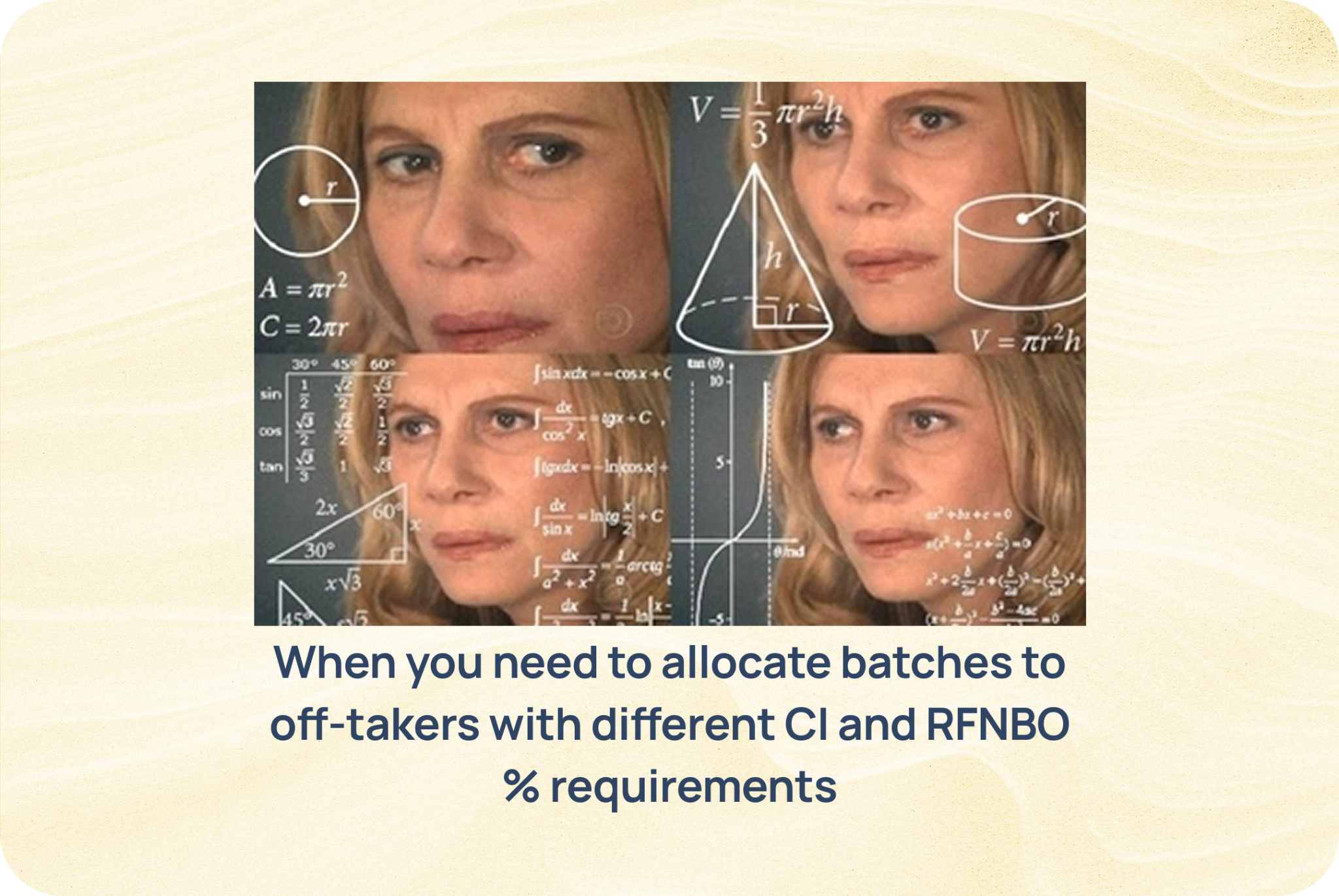
Once electricity is sourced, the next question is how attributes get distributed across output batches. This is the mass-balancing problem, and it's where allocation stops being a back-office task and becomes a commercial one.
For a given RFNBO volume, there are always multiple ways to split attributes across output batches. The challenge is splitting them well. A bad split is a waste of money and green molecules. It gets harder when you deliver to multiple off-takers with different needs. Each may have its own CI ceiling and RFNBO share requirement. The same megawatt-hour may pass for off-taker A and fall short for off-taker B.
Then there's a point that's often missed: as a processing unit, you remain responsible for reporting transport and distribution emissions (ETD) for your batches, even when off-takers pick up the molecules at your gate. A compliant batch at the gate can break the off-taker's contract once delivered, simply because it traveled by long-haul trailer. Anticipating downstream emissions is part of allocation, not a separate problem.
How the strongest operators handle this:

They know the off-taker's needs early (ideally as early as possible along the path to COD) and encode them as hard constraints. Early clarity allows smarter allocation later.
They calculate ETD early, too, because the answer changes the constraint. If off-taker A can only be reached by truck, that CI impact is reflected in the maximum well-to-gate threshold for that customer; if off-taker B is supplied via pipeline, the same calculation yields a different result, which feeds into the allocation logic.
Then they optimize month by month, allocating batches under clear constraints rather than broad averages.
One point worth being explicit about: RFNBO certificates can't be traded independently of the physical molecule. Unlike some electricity or gas certificate markets, RFNBO is mass-balanced. The certificate stays attached to a physical delivery. You won't trade it on its own. That's why traceability and allocation logic carry so much commercial weight: the certificate isn't a standalone instrument; it's a property of the molecule moving through your supply chain.

If your supply chain runs by road, this is the area many teams underestimate. Once your monthly batches leave the gate, they enter a multi-actor supply chain. As a producer (or a trader delivering to other traders), you can lose visibility on where each volume and its attributes end up.
The longer the chain, the more opaque it gets.
Real logistics are not A-to-B-to-A.The default response is to average all of these emissions across the supply chain. But averaging comes with two real costs: it obscures what is actually inside any given POS, and it inflates CI fast enough to threaten RFNBO compliance overall. In multi-hop supply chains, traceability isn't optional. Without it, compliance can fall apart.
Two questions follow:
What we see working: involve the next molecule owner early so transport and distribution emissions can be collected smoothly across the chain. Allow flexible data ingestion; not every counterparty has the same level of digital maturity, and rigid systems break down when that mismatch occurs.
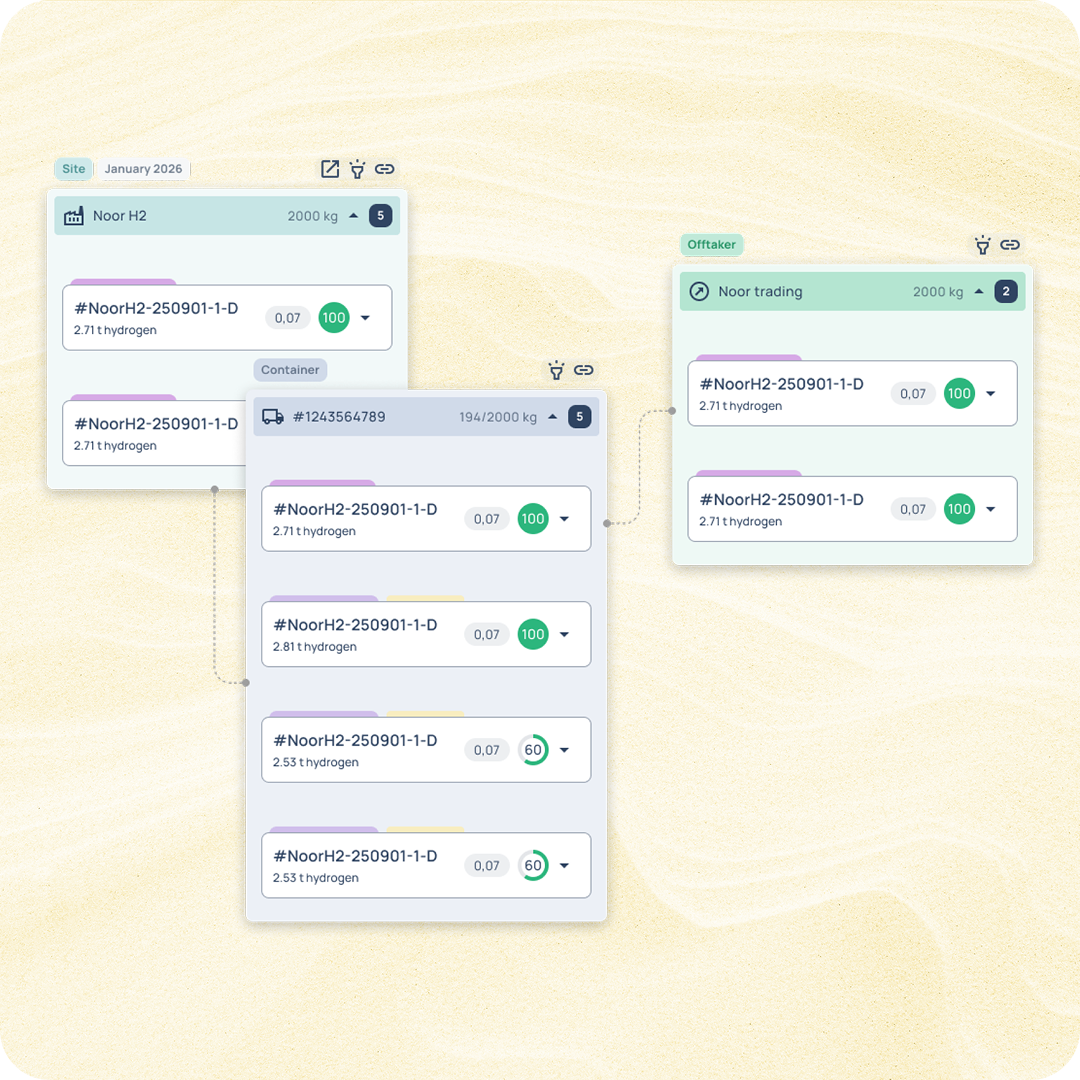
Know when to reconcile paper trades with physical operations, to avoid the black-box effect between commercial flows and the actual molecules. And when needed, go a level deeper than the batch, to container-level tracking that captures every split, transfer, and relocation. That's what preserves sustainability across the full downstream chain, not just at the production site.
The same logic extends past the production site. When a molecule is processed further (hydrogen converted to ammonia, ammonia handed to a trader, ammonia sold to a fertilizer plant), each step is its own mass balance. Each operator must account for inputs, process emissions, transport, and any feedback loops (e.g., heat or recycled streams). The supply chain isn't one mass balance; it's a chain of them, each accountable in its own right.
CI isn’t a number you calculate and report. It’s an optimization game, and the lower your CI, the higher the price your molecule will be able to command.
How you source electricity, how you split attributes across batches, how you track CI through logistics: these decide margin, not just compliance.
Interpretations vary across auditors and jurisdictions, and the same batch may need to be reported in slightly different formats to multiple places. In Germany, that could mean the certification scheme (e.g., CertifHy), the national registry (Umweltbundesamt), and, increasingly, the EU's Union Database. That's both a risk and an opportunity: a risk if you hard-code a specific interpretation into rigid data flows; an opportunity if your setup can absorb change without rework.
For teams currently navigating this, the practical questions to ask are:
Where is certification data stored today, who owns it, and how much of it could survive an audit without reconstruction?
Where is CI being modeled, and is it informing commercial decisions, or is it only reported after they are made?
Which operational choices are still open, and which are already constraining what you can certify?
The answers shape both compliance and profitability, usually at the same time.
Every project sits differently across these three levers. Let’s explore together how you could optimize your setup. Reach the team here.