Menu
Close

To provide the best experience, we use technologies like cookies to store and/or access device information. Consenting to these technologies will allow us to provide data such as browsing behaviour or unique IDs on this site. Not consenting or withdrawing consent may adversley affect certain features and fucntions.
Allow All
RED III is one of the EU’s key mechanisms for turning transport decarbonization ambition into market demand. It requires Member States to set binding obligations for fuel suppliers, determining how renewable fuels and renewable electricity can help reduce the carbon intensity of transport.
Spain has been a key market to watch. More than half of its electricity generation already comes from renewables, and the southern European country also holds some of Europe's largest biomethane production potential. While the ingredients for significant renewable fuel production are in place, the market has been waiting for greater clarity on the demand side.
That clarity arrived on 23 July 2026, with the publication of Royal Decree 611/2026.
The decree translates key RED III transport provisions into a Spanish framework running through 2040, with mandatory annual decarbonization obligations applying from 2027.
The obligations fall first on fuel suppliers, rail fuel suppliers, the wholesale and retail petroleum operators, LPG distributors, natural gas commercialisers and direct consumers that place fuels on the Spanish transport market. For them, the decree changes what they must deliver, prove and account for. For renewable fuel producers and traders, it defines where new demand will come from and under what conditions.
Beyond the top-line obligation, the decree sets dedicated subtargets and compliance routes for advanced biofuels, biogas and RFNBOs, each with its own trajectory through 2040.
So, what changes under the new Royal Decree, and what do those changes mean in practice for renewable fuel producers and the buyers they supply?
The changes at a glance:
Under Spain's previous framework, renewable fuel obligations were primarily expressed in energy content. Royal Decree 611/2026 changes the center of gravity: annual GHG-reduction targets now provide the overarching compliance framework, while fuel-specific subtargets remain in energy terms.
The direction will feel familiar to those tracking the Dutch transition from HBEs to EREs, where emissions reduction, rather than renewable energy volume, now carries the weight. Germany's framework uses a similar architecture, combining an overarching GHG-reduction obligation with dedicated fuel subtargets.
Spain applies that logic through its own modal trajectories. For road transport, the GHG-reduction target starts at 8.5% in 2027, rises to 17.6% in 2030 and reaches 30% in 2040.
The headline target only tells part of the story. The fuel-specific subtargets beneath it show where demand actually starts to build, and how differently each pathway is treated:
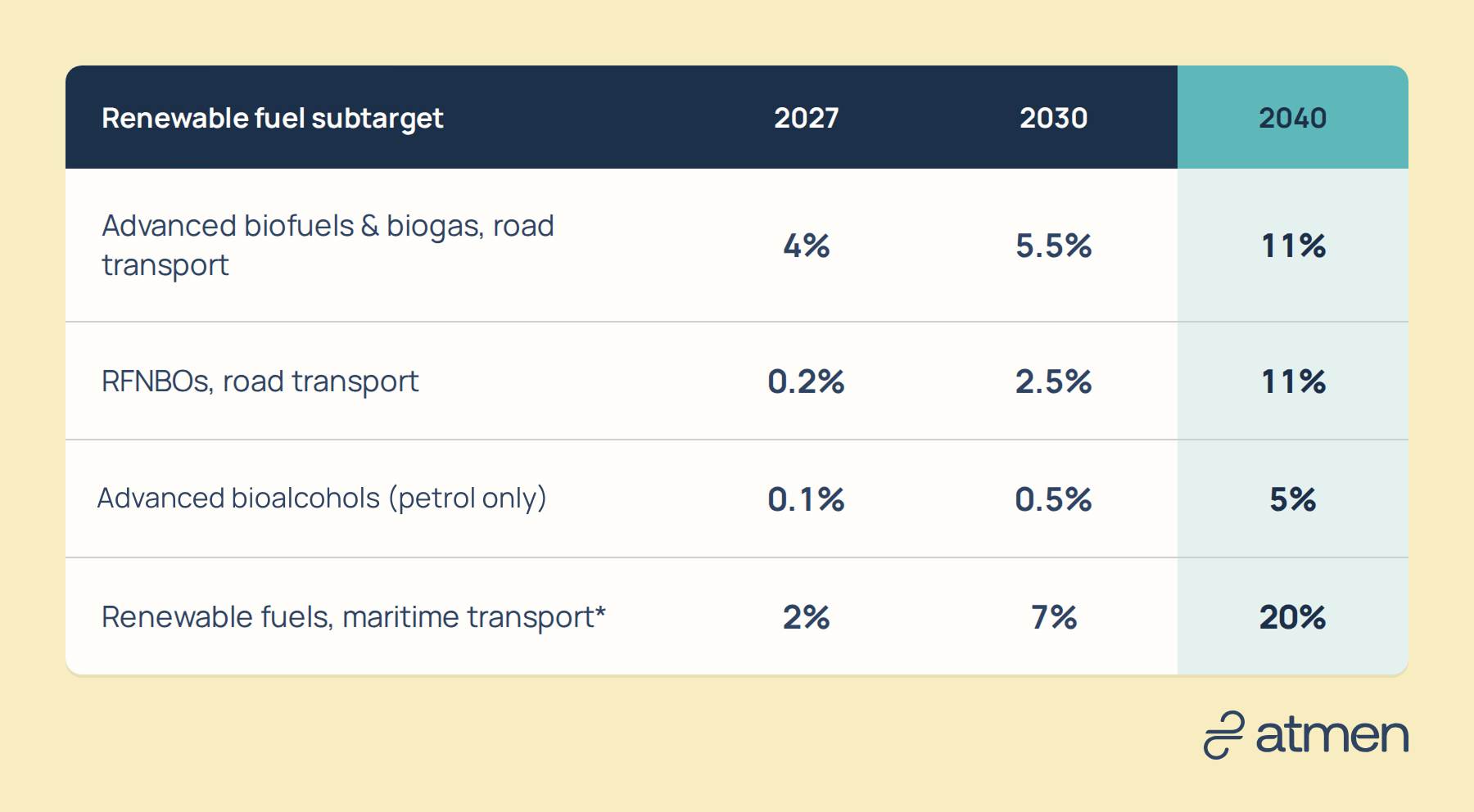
The scale becomes clearer against the EU minimum. RED III sets a combined 5.5% share for advanced biofuels, biogas and RFNBOs by 2030, including at least 1 percentage point from RFNBOs. Spain sets separate road-transport subtargets of 5.5% for advanced biofuels and biogas and 2.5% for RFNBOs, before the flexibility mechanisms available under the decree are taken into account.
The Spanish trajectory also extends well beyond 2030. By 2040, both the advanced biofuels and biogas subtarget and the RFNBO subtarget reach 11%. For comparison, Germany currently sets 2040 minimum shares of 9% for advanced biofuels and 10% for RFNBOs.
While RED III itself sets these fuel-specific minimums at EU level only through 2030, Spain gives buyers and producers a defined demand trajectory through 2040, offering considerably more visibility on how these renewable fuel pathways are expected to contribute over time.
Advanced biofuels and biogas enter the new framework from a much higher starting point than RFNBOs, making them especially relevant in the first years of compliance.
They also play a role in the RFNBO ramp-up. Through 2032, advanced biofuels and biogas can substitute part of the RFNBO subtarget, within flexibility corridors that differ by supplier profile.
Road fuel suppliers without refining capacity in Spain can use up to 1.5 percentage points in 2030, while those with refining capacity can use up to 1 percentage point (Article 14.3). Until 2030, low-carbon electrolytic hydrogen produced from renewable electricity can also qualify as a substitute under this flexibility (Article 14.1.b).
For buyers, that creates more room to combine different qualifying pathways while RFNBO supply scales.
The framework also allows excess advanced biofuel and biogas energy to count across road and maritime subtargets, within defined limits and once the relevant obligation has first been met.
Not all biofuel pathways are treated equally, however. The maximum contribution from food- and feed-crop-based fuels will be set by ministerial order and cannot exceed 7% of total transport energy. Biofuels and biogas produced from Annex I Part B feedstocks are generally capped at 1.7%, subject to the adjustment conditions established in the decree.
For RFNBOs, the story is different: the demand signal strengthens as the substitution flexibility falls away. Under Article 14, the mechanism allowing other eligible fuels to substitute part of the road RFNBO subtarget drops to zero from 2033. For obligated buyers, that increases the importance of securing qualifying RFNBO supply as the dedicated subtarget continues to rise.
Spain also creates a route for qualifying RFNBOs to generate transport compliance value even when the physical fuel is consumed elsewhere. Under defined conditions, eligible RFNBO producers can act as sujetos habilitados and request renewable-fuel certificates for RFNBOs sold or consumed in Spanish industry, or used as a final product in transport. Those certificates can then be transferred to obligated fuel suppliers and used towards transport decarbonization targets.
That creates an important link between industrial offtake and transport compliance: where and how an RFNBO is consumed can affect the compliance value attached to it.
The Royal Decree strengthens the demand side, but Spain is also supporting part of the supply side through separate funding mechanisms.
For renewable hydrogen, one example is Spain’s participation in the European Hydrogen Bank’s Auction-as-a-Service scheme. In May 2026, Spain awarded €439.4 million to three renewable hydrogen projects representing 250 MW of electrolysis capacity. The projects had been preselected at EU level but missed European funding after the auction budget was exhausted.
The support follows the Hydrogen Bank model: a fixed premium linked to verified and certified hydrogen production, paid for up to ten years.
While these programs sit outside Royal Decree 611/2026, they complete the picture: Spain is combining stronger regulatory demand with measures to help new production capacity reach the market.
The framework does not rely on targets alone. Royal Decree 611/2026 classifies non-compliance with obligations linked to biofuels and other renewable liquid and gaseous fuels as a very serious infringement under Spain’s Hydrocarbons Act.
A separate draft ministerial order for the future SICCRE certification system also proposes compensatory payments for annual shortfalls of:
The consultation on that draft closed on 15 September 2026, and the proposed amounts are not yet final. If adopted, they would add an explicit economic cost to falling short of the targets, on top of the sanctions framework already established in the Royal Decree.
Spain’s new framework makes one thing increasingly clear: the compliance value of a renewable fuel depends not only on the molecule itself, but on the decarbonization performance and sustainability attributes behind it.
For buyers and offtakers, procurement therefore becomes more than securing renewable fuel volumes. They need products with the GHG profile, sustainability characteristics and certification evidence required to meet their own obligations.
For producers, much of that value is shaped before the fuel reaches the market. Depending on the pathway, decisions around feedstocks, renewable electricity sourcing, process inputs, logistics and allocation can influence the final GHG performance, and ultimately how well that product fits an offtaker’s needs.
Renewable fuels are becoming a GHG optimization game as much as a production game. The molecule matters, but so does the verified decarbonization value that travels with it.
That optimization is what Atmen Automate was built for: turning GHG and sustainability data into sourcing, allocation and certification decisions that extract more value from every qualifying supply chain.
Last reviewed: early October 2026. Spain's renewable fuel framework is still being finalised through implementing orders; some figures and procedures referenced here remain under adoption.
What is Spain's Royal Decree 611/2026?
Royal Decree 611/2026, published on 23 July 2026, is Spain's transposition of the EU's Renewable Energy Directive (RED III) for the transport sector. It sets Spain's transport decarbonisation framework through 2040, shifting renewable fuel obligations from energy volumes to annual GHG reduction targets differentiated by transport mode, with specific subtargets for advanced biofuels, biogas, and RFNBOs. Most provisions apply from 1 January 2027, over a year after the original EU transposition deadline of 21 May 2025.
What are Spain's GHG reduction targets for road transport under RED III?
Under Royal Decree 611/2026, Spain's road transport GHG reduction target starts at 8.5% in 2027, rises to 17.6% in 2030, and reaches 30% in 2040, broadly in line with RED III's ambition but implemented through Spain's own compliance architecture, combining overarching GHG targets with minimum energy-based subtargets for specific fuel pathways.
What are the RFNBO subtargets under Spain's RED III transposition?
Spain sets an RFNBO road transport subtarget of 0.2% in 2027, rising to 2.5% in 2030 and 11% in 2040, consistent with RED III's requirement that RFNBOs account for at least 1% of transport energy by 2030. Until 2032, fuel suppliers can substitute part of this subtarget with advanced biofuels and biogas, with a larger allowance for suppliers without refining capacity in Spain. From 2033, that flexibility closes entirely.
What does RED III require operators to demonstrate for RFNBO qualification?
Under RED III, operators must demonstrate that the electricity used is of renewable origin and that the fuel achieves at least 70% GHG savings against the fossil comparator, verified through an EU-recognised voluntary or national scheme.
Spain's framework applies these same requirements: connecting feedstock or electricity inputs, GHG performance, volumes, traceability, and certification into evidence that holds up to third-party audit.
Can RFNBOs used in Spanish industry count towards transport targets?
Yes, under specific conditions. Eligible actors can request renewable-fuel certificates for RFNBOs sold or consumed in Spanish industry. Those certificates can then be transferred to obligated fuel suppliers and used towards Spain's transport decarbonization targets, creating a compliance route for RFNBOs even when the physical fuel is consumed outside the transport sector.
What are the penalties for non-compliance with Spain's renewable fuel obligations?
A draft ministerial order whose public consultation closed on 15 September 2026 proposes compensatory payments for annual shortfalls:
Non-compliance with these obligations is also classified as a very serious infringement under Spain's Hydrocarbons Act. As of early October 2026, the compensatory payment figures are not yet final; the ministerial order has not yet been published in the BOE.