Menu
Close

To provide the best experience, we use technologies like cookies to store and/or access device information. Consenting to these technologies will allow us to provide data such as browsing behaviour or unique IDs on this site. Not consenting or withdrawing consent may adversely affect certain features and functions.
Allow All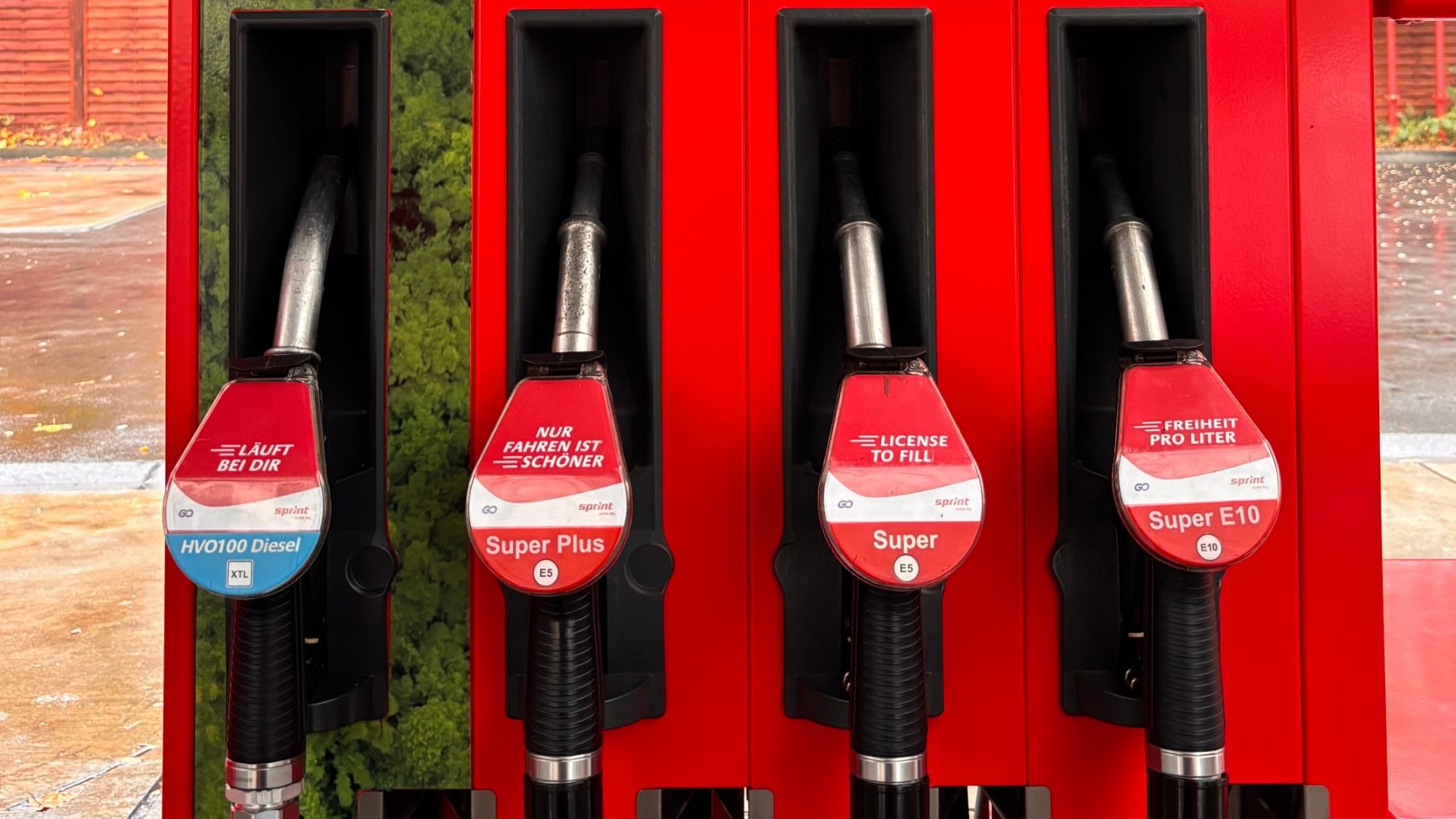
By Alejandra Patricio, Content Manager at Atmen
Hydrotreated vegetable oil (HVO), a renewable alternative to fossil diesel, usually comes at a higher price than its fossil counterpart.
But in September 2026, the premium for HVO100, its pure, unblended form, narrowed to an estimated 4–8 cents per liter at many German gas stations, according to figures reported by Münchner Merkur. Given the different implications of renewable and fossil diesel for sustainability and energy security, coming this close to price parity is worth a closer look.
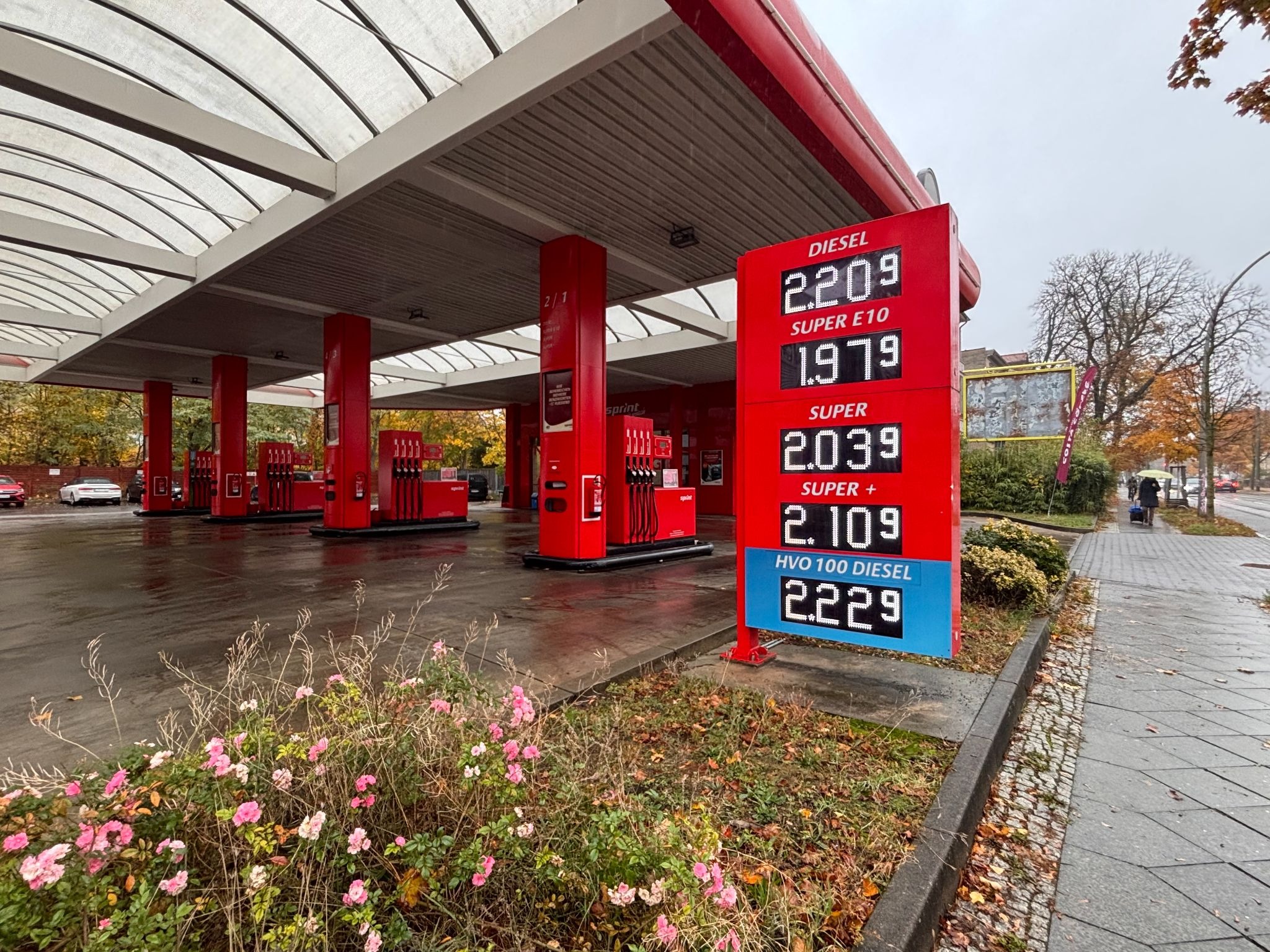
Curious to see the difference for myself, I ventured into a cold, gray Berlin afternoon and headed to a gas station near Friedrichshagen. On October 28, HVO100 was priced at €2.229 per liter, compared with €2.209 for fossil diesel. Only 2 cents apart.
But what's behind these unusually close prices? Geopolitical disruptions have sent fossil diesel prices soaring, but Germany's energy taxes, CO₂ pricing and GHG quota have also played a role, each in a different way.
Unlike fossil diesel, which is refined from crude oil, HVO is produced by treating oils and fats with hydrogen, using feedstocks that can include used cooking oil and animal fats.
Its lifecycle greenhouse gas emissions can differ significantly from those of fossil diesel. HVO’s sustainability performance depends on factors such as its feedstocks, production process and supply chain.
The war involving Iran and disruptions around the Strait of Hormuz have put significant pressure on global oil markets, driving prices sharply higher.
In Germany, diesel prices rose from a monthly average of €1.69 per liter in January 2026 to a record €2.39 in September, according to ADAC, the country's largest automobile association.
HVO prices also rose, but less sharply. Unlike fossil diesel, which is closely tied to global crude oil and petroleum product markets, HVO follows a different feedstock and production cost structure. When produced from European waste oils and fats, it can be less directly exposed to disruptions in conventional oil supply, although wider energy and feedstock markets still influence its price.
But market forces are only part of the equation. Taxation and regulatory incentives add another layer to the economics of both fuels.
Three regulatory mechanisms are particularly relevant to understanding the price relationship between fossil diesel and HVO.
To ease the impact of the energy crisis, in 2026 Germany's Bundestag and Bundesrat approved two exceptional temporary tax cuts, applied equally to both fossil diesel and equivalent renewable fuels, including HVO.
The first applied from May 1st through June 30th, followed by a second from October 1st expiring on December 31st, unless extended.
In both periods, the energy tax was then reduced by 14.04 cents per liter, equivalent to roughly 17 cents including VAT.
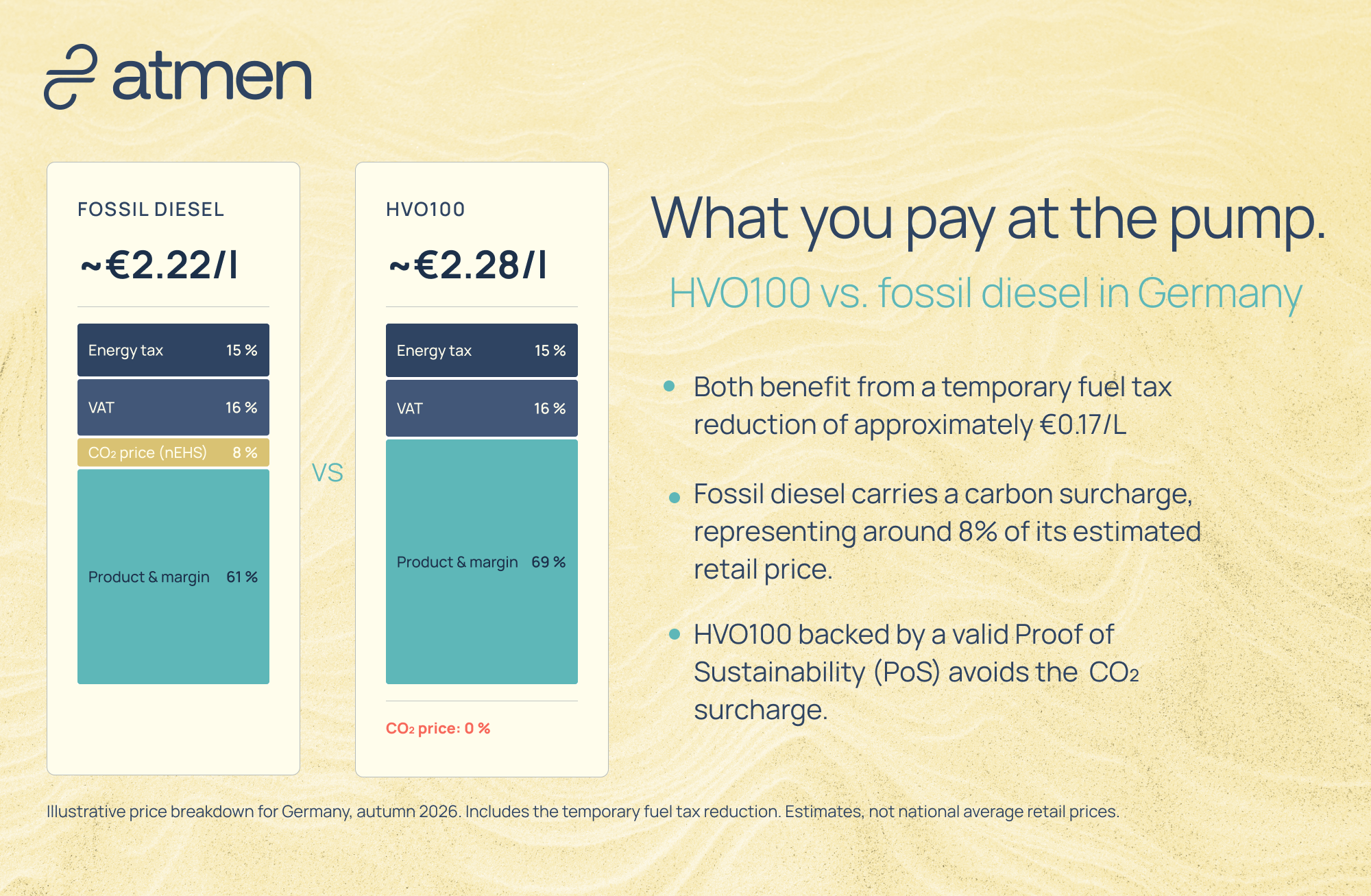
To illustrate the impact, the graphic uses estimated average pump prices of €2.22 per liter for fossil diesel and €2.28 for HVO. Under normal tax rates, these would be approximately €2.39 and €2.45, respectively, assuming unchanged market conditions and full pass-through of the tax reduction. Our spot check in Berlin on October 28 found an even narrower gap of 2 cents.
Under Germany’s national emissions trading system (nEHS), fuel suppliers must purchase allowances for the CO₂ emissions associated with fossil diesel. This cost, equivalent to roughly 8% of its current pump price, helps narrow the price gap between HVO and fossil diesel.
Certified HVO is exempt from this CO₂ charge, provided its sustainability is documented through a valid Proof of Sustainability (PoS).
Germany's GHG reduction quota (THG-Quote) requires fuel suppliers to achieve emissions reductions of 12% in 2026 and 17.5% in 2027, under §37a of the Federal Immission Control Act.
Relying solely on fossil fuels means meeting these obligations through other eligible emissions reductions at additional cost. Selling qualifying HVO, by contrast, helps meet the quota, creating a financial incentive to supply renewable fuel at the pump.
From a chemical perspective, HVO and fossil diesel might look alike. Yet their sustainability performance and resilience to supply disruptions can differ significantly. As fuel markets and regulatory requirements evolve, these differences increasingly affect how fuels are priced and valued.
For fuel suppliers, having the right infrastructure to distinguish fossil from non-fossil fuels is essential to future-proofing their business. The sustainability and emissions data associated with each fuel batch must travel with the product throughout the entire supply chain, all the way to the pump.
Atmen helps HVO traders and operators continuously compile, validate and trace this information, ensuring it is robust, evidence-backed and ready for certification and audits.
Mainly because fossil diesel became much more expensive during 2026. Diesel in Germany rose from a monthly average of €1.69 per liter in January to a record €2.39 in September, according to ADAC, driven by supply disruptions around the Strait of Hormuz. HVO prices rose less sharply. Germany’s CO₂ price, which applies only to fossil diesel, and the GHG quota also contributed. By September 2026, HVO100 cost an estimated 4–8 cents more per liter than diesel at many German gas stations, according to reporting by Münchner Merkur, and an Atmen spot check in Berlin on October 28 found a gap of just 2 cents.
It is treated as fossil fuel. Under §37a of Germany’s Federal Immission Control Act, biofuels without valid, recognized proofs cannot count towards the GHG quota, and they are not exempt from the national CO₂ price. A valid Proof of Sustainability records how the fuel was produced and its lifecycle emissions. It is what turns HVO’s lower emissions into economic value for fuel suppliers.
Neither. Both temporary cuts applied equally to fossil diesel and renewable fuels such as HVO: 14.04 cents per liter, about 17 cents including VAT, first from May 1 to June 30, 2026 and again from October 1 to December 31, 2026, unless extended. The cut lowers pump prices for both fuels.
Last reviewed: November 2, 2026. Fuel prices and temporary tax measures are time-sensitive; figures refer to the periods indicated.