Menu
Close

To provide the best experience, we use technologies like cookies to store and/or access device information. Consenting to these technologies will allow us to provide data such as browsing behaviour or unique IDs on this site. Not consenting or withdrawing consent may adversely affect certain features and functions.
Allow All

At an estuary, freshwater from a river or stream meets saltwater from the open sea. Two flows with different origins and properties come together in the same body of water.
Once they mix, it's no longer about following individual drops, but understanding what each flow contributes.
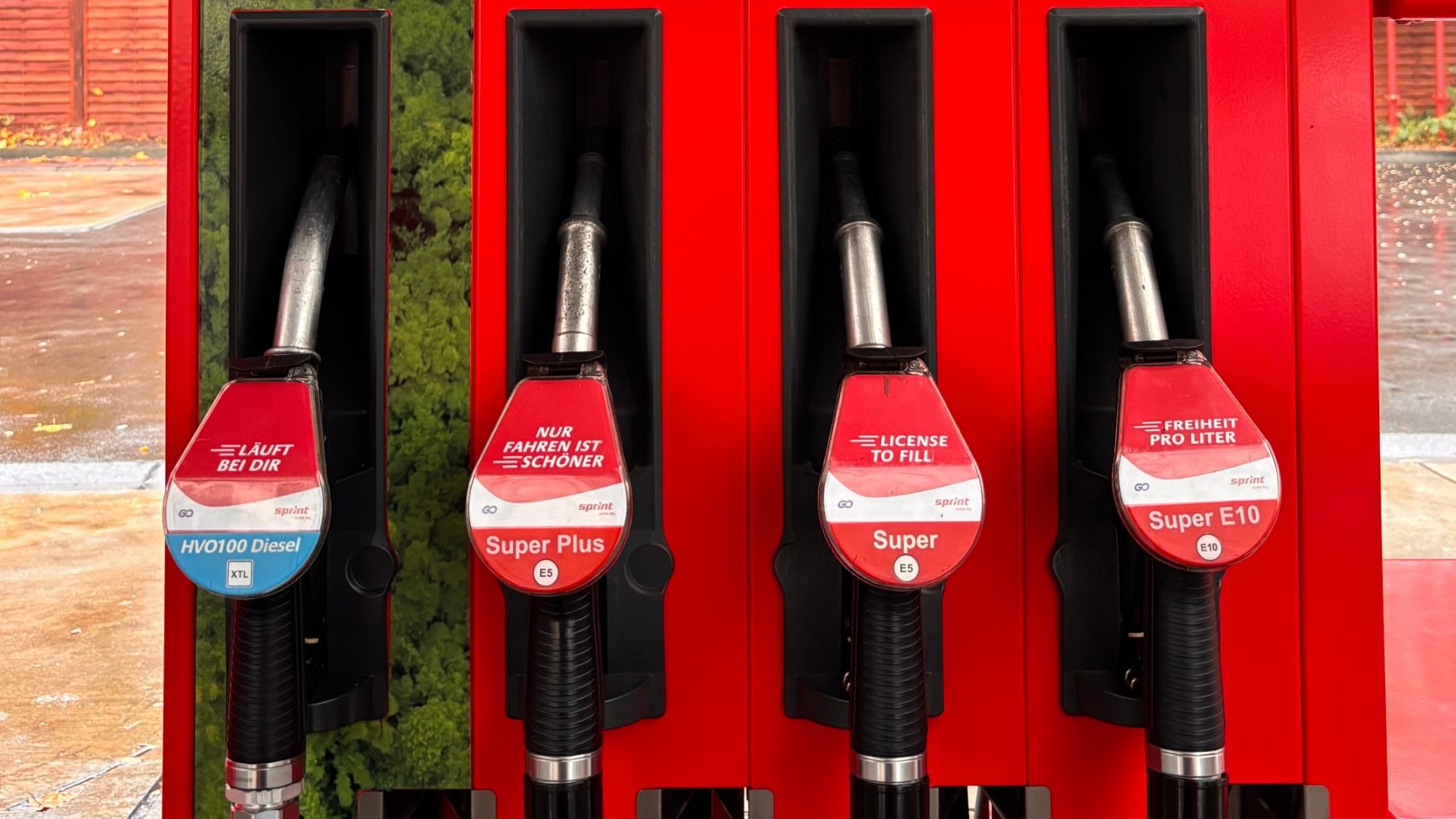
Something similar happens in renewable fuel supply chains. Renewable and fossil fuels can share pipelines, storage facilities, and production infrastructure.
So how can operators keep track of renewable inputs, their quantities, and their sustainability attributes when different sources share the same system?
That's where chain of custody comes in, a framework intended for tracking materials and their associated characteristics throughout the supply chain.
One of its models is particularly relevant to renewable fuels: mass balance.
Not every supply chain tracks sustainability characteristics in the same way. Some models require certified materials to remain physically separate, while others allow greater flexibility.
ISO 22095 provides a general framework for chain of custody across industries. Four commonly discussed models help illustrate the differences:
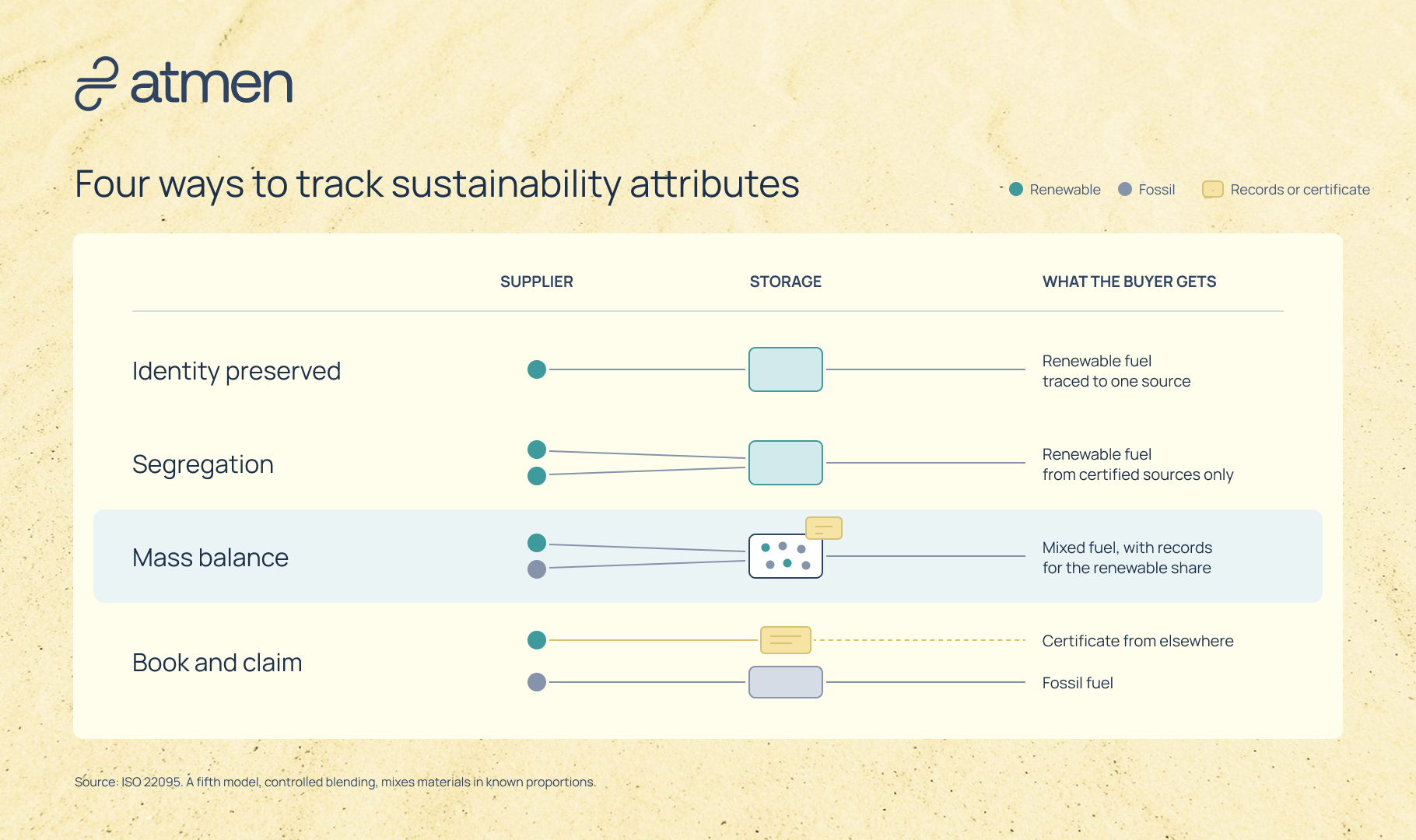
Mass balance occupies a middle ground, offering greater flexibility than identity preservation or segregation while maintaining a connection between sustainability attributes and physical material flows.
This distinction is particularly relevant when renewable and fossil fuels share infrastructure.
Mass balance is a chain-of-custody model that lets materials with different sustainability characteristics share a production, storage, or transport system while tracking the quantities and attributes associated with its inputs and outputs.
Think of a storage facility receiving two deliveries of a compatible fuel: one certified as renewable and the other fossil. Under the relevant conditions, both can enter a shared tank.
Once mixed, the point is no longer to identify which molecules came from each delivery. But how can the operator demonstrate how much fuel entered the system, which sustainability characteristics accompanied it, and how those characteristics are assigned to the fuel leaving it?
In practice, three principles keep the system accountable:
These principles are reflected in the EU's Implementing Regulation 2022/996, which establishes requirements for applying mass balance in renewable fuel supply chains.
Together, these controls allow materials to share infrastructure without losing accountability for their sustainability attributes.
Beyond tracking sustainability attributes, mass balance has practical implications for how renewable fuels are produced, distributed, and certified.
Building dedicated pipelines, storage tanks, and production facilities for renewable fuels would introduce significant logistical challenges and additional investment.
Mass balance offers an alternative. Where the applicable rules permit, renewable and fossil materials can share infrastructure while their quantities and sustainability characteristics remain accounted for.
Biomethane illustrates this well. According to the 2026 European Biomethane Map by GIE and EBA, Europe has 1,974 biomethane production facilities, with at least 86% connected to the gas grid.
Rather than requiring a separate network, biomethane can be injected into existing gas infrastructure alongside fossil natural gas.
Mass balance allows renewable materials to enter established supply chains without waiting for entire facilities to operate exclusively on renewable inputs.
Where permitted, a producer can start with a smaller share of eligible renewable material and increase it over time, while continuing to meet the relevant certification requirements. This flexibility supports the gradual expansion of renewable fuels through existing production and distribution systems.
Keeping certified materials separate throughout production, storage, and transport can require dedicated equipment and logistics.
By allowing eligible materials to share facilities, mass balance can reduce some of these additional costs.
That doesn't necessarily make mass-balanced fuels cheaper, as savings depend on the infrastructure, production pathway, and certification requirements. But avoiding unnecessary physical separation can make the integration of renewable materials more feasible economically.
For fuel suppliers, mass balance also has a regulatory function.
Under the EU Renewable Energy Directive, eligible renewable fuels must meet specific sustainability and greenhouse gas emissions-saving requirements to count towards relevant renewable energy targets.
Mass balance provides the chain-of-custody framework for maintaining and transferring the required information throughout the supply chain. A Proof of Sustainability (PoS) documents the relevant attributes of a certified fuel batch, supporting its recognition under applicable requirements.
For renewable hydrogen, this has direct implications. Under RED III (Article 22a), at least 42% of the hydrogen used in industry must be renewable fuel of non-biological origin (RFNBO) by 2030, rising to 60% by 2035. To count towards these targets, RFNBO hydrogen needs a PoS, which relies on mass balance.
This differs from a Guarantee of Origin (GO), which serves a separate purpose and cannot, on its own, replace the sustainability evidence required for renewable fuel certification.
Mass balance therefore helps ensure that renewable fuel quantities retain the documented attributes needed for recognition under the relevant rules.
For an estuary, the meeting of the two streams is just a stop within a broader journey. The same is true of renewable fuels: once feedstocks enter a shared system, they continue to move, change hands, and, at times, undergo further transformation processes.
Tracking materials is only one aspect of the task. Their sustainability attributes, allocations, and supporting documentation must remain consistent and verifiable throughout the supply chain.
Through Atmen Automate, Atmen provides ongoing support to operators and traders, connecting operational data, maintaining mass balances, and keeping records traceable and ready for certification and audits.
Experience how Atmen Automate can help.
Yes, where the applicable regulations and certification rules permit it. Mass balance allows eligible materials with different sustainability characteristics to share certain facilities while their quantities and associated attributes are accounted for separately.
Mass balance maintains a connection between sustainability attributes and physical material flows within a defined system. Book and claim allows certificates or credits to be transferred independently of the physical product, subject to the rules of the relevant scheme.
For renewable fuels counted towards EU targets, however, there is no choice between the two. Article 30(1) of the Renewable Energy Directive requires economic operators to use a mass balance system to show that the sustainability and greenhouse gas emissions-saving criteria have been met. Book and claim instruments, such as Guarantees of Origin, cannot be used for this purpose.
No. Mass balance is a chain-of-custody method, not a certification in itself. A fuel must still meet the applicable eligibility, sustainability, and greenhouse gas emissions-saving requirements, with the necessary supporting evidence and verification.